
Daytona Beach Directory Runs
The surviving shelf is substantial but not annual. Known Daytona and Daytona Beach editions begin in 1914 and continue through selected years to 1960, with later regional editions noted for 1971 and 1974. Separate Seabreeze runs survive for several early years. Publishers and titles vary. R. L. Polk is common in later local research, but an early book must be identified from its own title page.
| Collection | Years or scope | Where held | Access |
|---|---|---|---|
| Daytona / Daytona Beach city directories | 1914-17, 1920-26, 1930, 1932, 1935, 1937, 1939, 1941, 1944, 1946-47, 1949, 1951, 1955-60; selected later editions | Library databases, State Library catalog, major microfilm collections | In-branch Ancestry; catalog and affiliate limits vary |
| NARA census-use directories | 1930, 1932, 1935; regional coverage | National Archives | Consult holding and access rules |
| Daytona telephone books | November 1939-December 1947 and June 1948-December 1954 | Library of Congress collection | Digitized images where available |
| Sanborn maps | 1895, 1901, 1906, 1912, 1916, 1920, 1924; later update references | Library of Congress and local collections | Public-domain sheets free; later access varies |
| Newspapers and obituaries | Dates vary | Volusia County Public Library NewsBank and microfilm | Card or branch access by product |
These ranges report known editions, not a promise that every listed volume is online. Ask a repository to confirm a year and format before making a trip.
Three Daytona Directory Headings
Daytona, Daytona Beach, and Seabreeze consolidated in 1925. That event changed headings without always moving a household. A 1924 Seabreeze entry can become a 1926 Daytona Beach entry at the same site. Search all three names in catalogs, newspapers, maps, and directory indexes for any pre-consolidation person or address.
Separate Seabreeze editions are known for 1914-15, 1922-26, 1930, and 1935. Treat the publication year as a snapshot. The municipal label, street number, and spelling may change even while the family remains in place. Consecutive books and a map can distinguish a real move from a renamed place.
Daytona Beach Directories at NARA
The National Archives directory list specifically identifies Daytona Beach-area volumes for 1930, 1932, and 1935. These books were retained to support census work. Their scope reaches beyond Daytona Beach to communities including Allandale, Bulow, Holly Hill, National Gardens, Ormond and Ormond Beach, Port Orange, and Rio Vista.
The captured NARA page makes that three-year holding and regional scope visible.
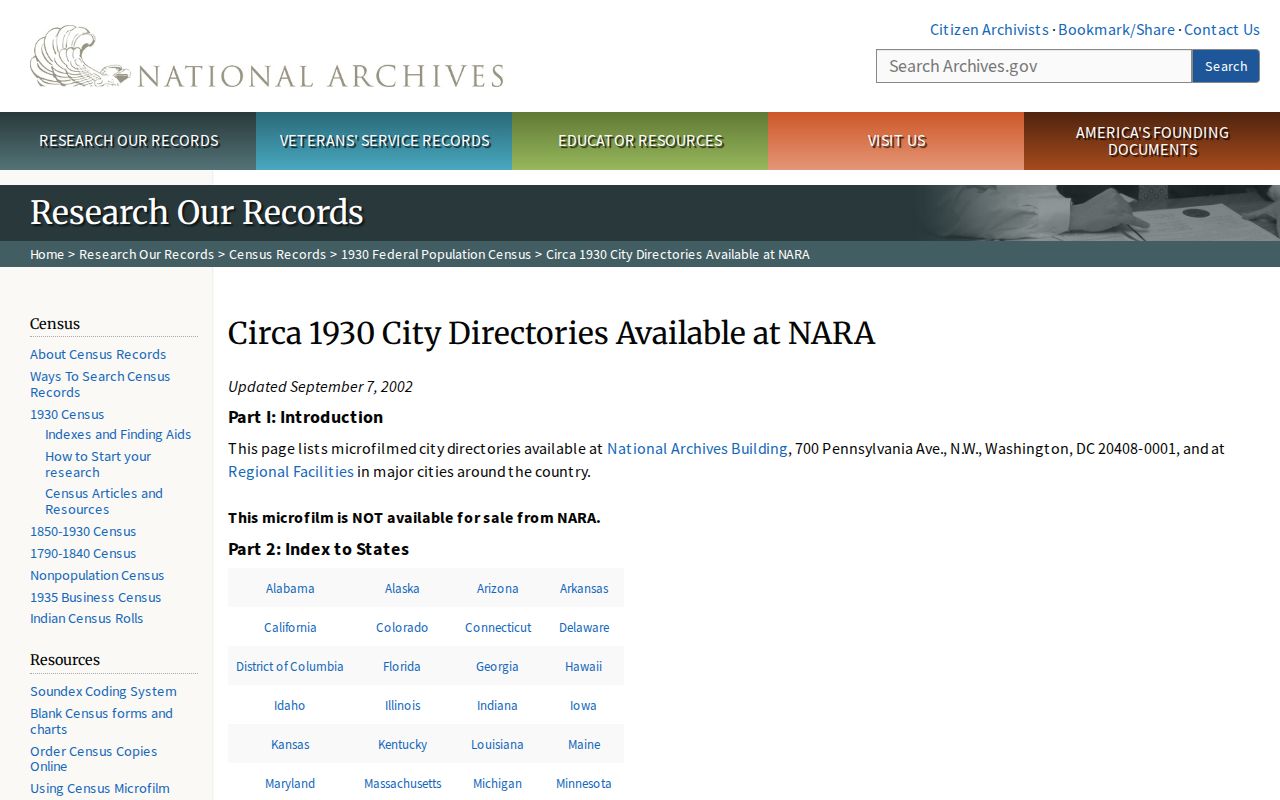
A Daytona Beach title is therefore not proof of legal city residence. Preserve the locality printed with an entry, then compare it with a census place or parcel municipality.
Read a Daytona Beach Entry
Start with the title page and abbreviation key for the exact year. A typical alphabetical entry can include surname, given name or initial, spouse in parentheses, trade or occupation, business affiliation or address, and home address. Some books mark a homeowner, renter, or telephone number. Business entries may name officers and appear again in classified pages.
| Entry part | What to record |
|---|---|
| Name | Full printed form, initials, spelling, and spouse in parentheses |
| Work | Occupation, employer, or business address as printed |
| Home | Street number, street name, and any residence mark |
| Status marks | Homeowner, renter, widow, boards, or rooms notation only after checking the key |
| Locality | The town or community label, especially in regional volumes |
Common forms may include h for house or home, bds for boards, and wid for widow. The letter r can depend on context. Never impose a later convention on a 1930 or 1935 book.
- Criss-cross directory
- A reverse section arranged by street and number rather than surname.
- Householder index
- An address-oriented listing of the person presented as the householder in that edition.
- Abbreviation key
- The volume's own legend for short forms and marks; photograph or transcribe it before entries.
Daytona Beach Library Genealogy
The Volusia County Public Library database list is the first local access check. Ancestry Library Edition is available inside a branch. NewsBank and other licensed products may work remotely with a library card. Those resources connect directories with the Daytona Beach News-Journal, obituaries, census material, and other family-history evidence.
The captured database page shows the official access point rather than a commercial directory copy.
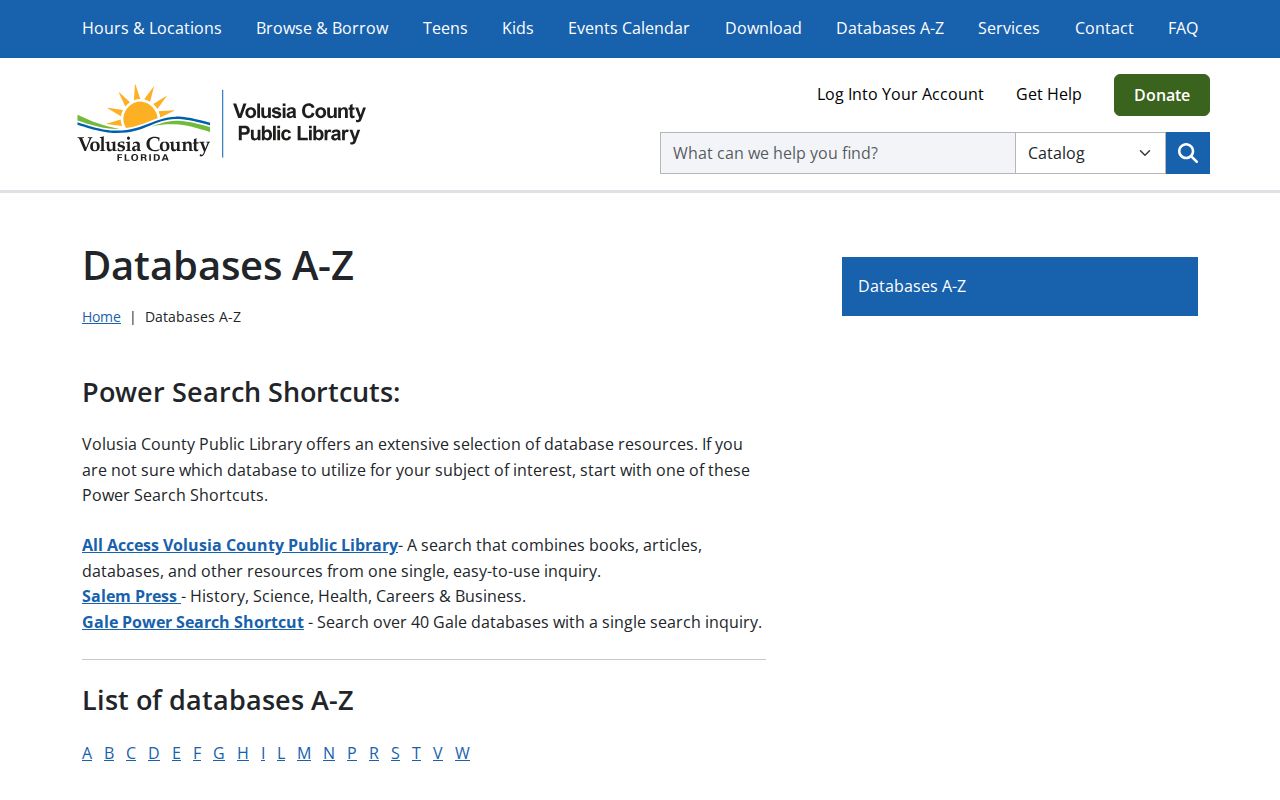
Ask the Daytona Beach Regional Library about a specific title and year before assuming that a catalog record means a volume is on an open shelf. Staff can help identify database or reference routes, while image rights and remote access depend on the collection.
Florida's Daytona Directory Shelf
The State Library of Florida city-directory collection spans more than a century and is arranged by city and year on site. Search its catalog under Daytona, Daytona Beach, and Seabreeze, then contact the reference desk at 850-245-6682 to confirm holdings and use. A catalog description is not necessarily a digitized book.
The State Library's collection page is captured below.
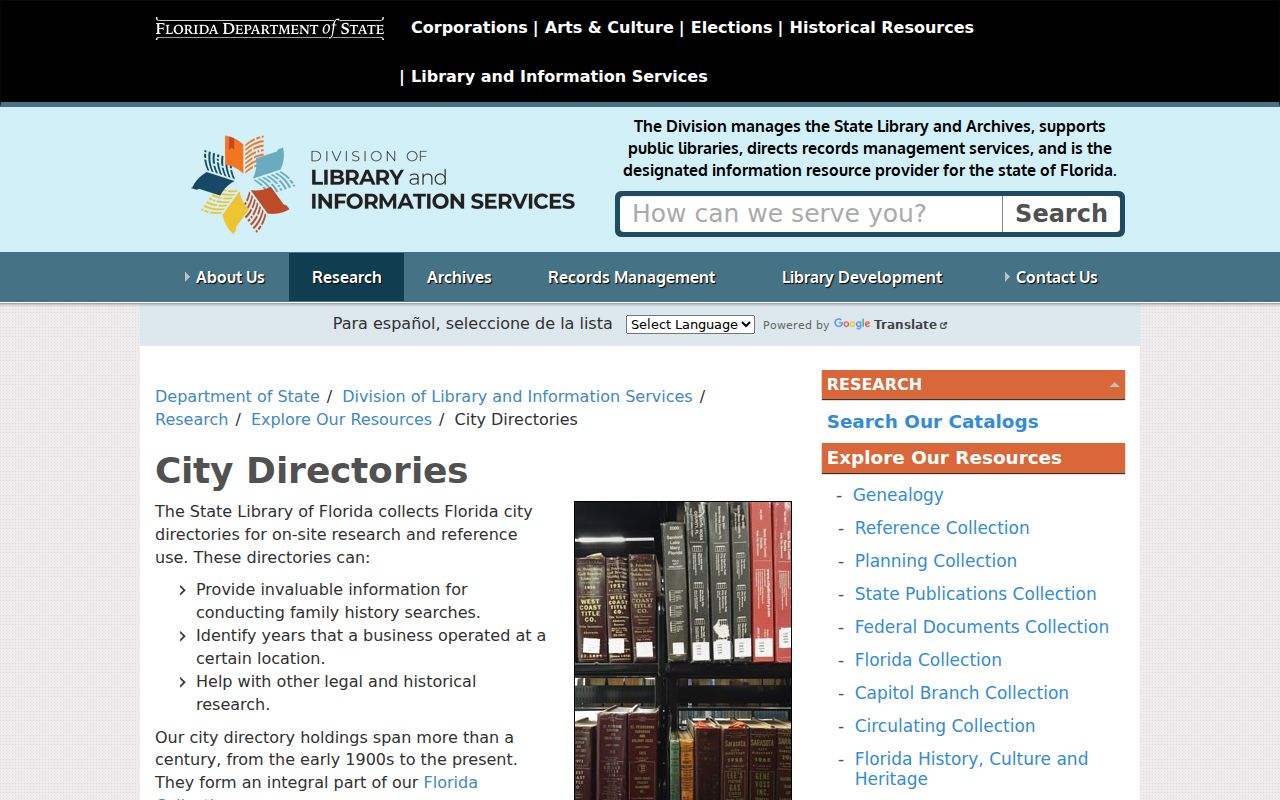
The State Archives adds family and local histories, immigration files, census sources, church and cemetery material, military records, and a family-name vertical file. Florida Memory provides selected digital items, but its more than 320,000 items represent under two percent of State Archives holdings. Catalog and reference work still matter.
Note: Search all three historic locality names even when the State Library catalog appears to return a complete Daytona Beach run.
Halifax Daytona Beach Collections
The Halifax Historical Society, at 252 S. Beach Street, adds local photographs, files, exhibits, and historical research context. Its value is not a promised annual city directory shelf. It can help identify an old business, streetscape, institution, or family name that appears in a terse entry.
The society's public landing page is shown below.
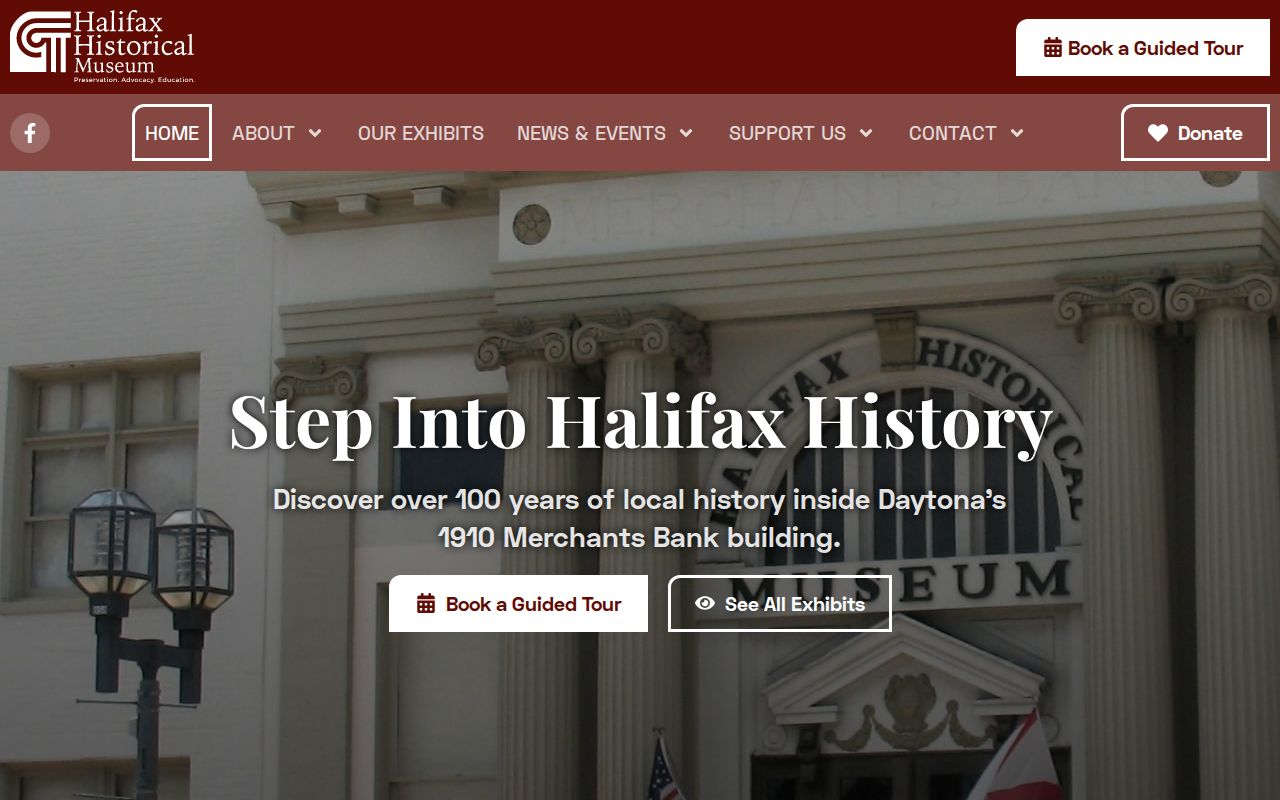
Contact the society about the exact person, street, business, and date. A narrow question lets local staff connect the printed line with photographs or vertical files without claiming a holding the published research does not document.
Reverse Daytona Beach Directories
An alphabetical city directory answers where a named person appears. A reverse section begins with the street and house number. When present, it can reveal the listed occupant or business and nearby entries for that publication year. It is valuable for a house history, but it is not a modern resident roll.
Look up the street heading, copy each number exactly, and note vacant lots, apartments, businesses, missing numbers, and spelling. Multiunit buildings can be compressed or incomplete. For present-day address-keyed sources, shift to the Daytona Beach street directory, which owns the parcel, deed, permit, and voter-data chain.
Map a Daytona Beach Directory
Sanborn fire-insurance maps show building footprint, material, use, and old street context, not occupants. Known local editions include 1895, 1901, 1906, 1912, 1916, 1920, and 1924, with later update references. The digitized November 1916 Library of Congress set has nine sheets and expressly includes Seabreeze.
Use three independent artifacts for an old address: the directory street entry for the listed occupant, a Sanborn sheet for building and address geometry, and a deed or plat for title and legal land identity. This method is safer than forcing a current street number onto an old entry. No verified comprehensive renumbering table was found.
Daytona Beach Directory Timeline
The local sequence shows why one catalog query is not enough. It also provides clear checkpoints for testing a person or street.
| Date | Directory or records event |
|---|---|
| 1914 | Earliest known surviving Daytona directory run cited in the research |
| 1916 | Nine-sheet Sanborn map covers Daytona and Seabreeze |
| 1925 | Daytona, Daytona Beach, and Seabreeze consolidate |
| 1930, 1932, 1935 | NARA retains regional directories for census use |
| 1955-1960 | Known later continuous directory run |
| 1971 and 1974 | Selected regional editions appear in later microfilm bibliographies |
The timeline does not establish publication in an unlisted year. Telephone books can help fill portions of the 1939-1954 period, while newspapers and census records test a disappearance or move.
Trace Daytona Beach Families
City directories fill the years between federal censuses. They can show a move, spouse, change in work, widow notation, or the first and last known appearance at an address. A missing person might have died, moved, been omitted, changed name, or simply gone unlisted. Test the possibilities instead of choosing one.
- Find the person in a known year and copy the entire entry plus title, page, locality, and key.
- Search the prior and next available volumes under surname variants, initials, spouse, and the three historic locality names.
- Check a reverse section, when present, to compare the address and neighboring listings.
- Pair the 1930, 1940, and 1950 directory years with the corresponding released federal census.
- Use newspapers, obituary evidence, marriage or court records, and deeds to resolve a disappearance or name change.
Federal census records through 1950 are public; the 1960 census remains closed until 2032 under the 72-year rule. Florida state censuses add decennial evidence through 1945. For Black family history, Florida Memory's digitized 1867-1868 voter rolls can add race, nativity, residence duration, and naturalization, while Bethune-Cookman, church, and Black newspaper sources may address omissions or segregated language in printed directories.
Modern confirmation belongs in official current sources. The Daytona Beach resident lookup can help test a name found in a late volume without recasting the historical shelf as present-day proof.